travel into occupied territory (24 april - 14 may 05)
It is with butterflies in our bellies that at 3am, we got on our bikes, and under a friendly and sympathetic full moon, rode into Tibet. We discreetly passed the 2 checkpoints in Yanjing - the first Tibetan town after the border with Yunnan. Not only were we scared of the police uniforms, but also of the Tibetan dogs who, in the great silence of the night, bark until they drop. Most of them are tied up to something. But not all of them. Our levels of adrenaline go through the roof, we barely speak to each other. But with Yanjing behind us, and the first rays of the sun warming us up and putting a smile on our faces, we celebrate our first small victory: we have made it into Tibet.
Today, sitting down in a small cafe in Lhasa, sipping a cup of Tibetan tea, and making the most of the warmth inside, I try to decide where this story should start... Lifting my eyes from the computer screen, I can see images passing through my mind. Is it the Tibetan music playing in the background or the fact that we now get to relax after 3 exhausting weeks? I am not sure but I surprise myself stopping tears coming into my eyes...
Still, the pictures keep coming through: flashes of colours, temperatures, and extreme feelings.
First, all those Tibetans who welcomed us along the road, who sheltered us from the cold, the wind or the snow falling. For a few moments: time to have a cup of tea, a bit of food and always, time to speak about the dalai-lama with reverence, admiration, affection and deep feelings. How can we describe these men and women? Their faces have been carved by life and their history. Their wrinkles seem to hide secrets that cannot be told. Their eyes look at us, through us, so deep, so mysterious. They dress with layers and layers of clothing and yak skins stacked on top of each other to keep warm. They work the fields, so rocky, so rough, so steep, as best they can. They look like the summits around them: tough, extreme. But all - no matter the age - are related through their beliefs, their faith and the dalai-lama, who has been in exile for so long already. As we are getting warm in those little Tibetan homes, they show us pictures of him: the pictures are hidden behind the curtains at the other end of the room, or pinned into the inside of an old woolly hat. They are not allowed to have pictures of him or to show them, but he is everywhere. He is a link between all of them. He seems to be their reason for hope, for work, for life. Nothing has destroyed that (not for lack of trying): neither the 1.2 million Tibetans' deaths since China invaded Tibet, nor the completely out of proportion presence of the Chinese army and police around Tibet, nor the systematic destruction of monasteries and other religious symbols over the years, nor today the accelerated Chinese immigration into Tibetan country.
It is difficult to know what to do and how to react. We are sitting in those homes, on seats made of bits of wood and yak skins, in almost complete darkness. The only source of light is the fire in the centre of the unique room. Their faces watch us, constantly. They tell us about the dalai-lama. They bless us. They smile. They ask us to have a prayer for them in Lhasa, where they all dream of going one day... They also laugh at the size of Mike's feet (size 47 is not that common around here) or at his beard... These meetings are so simple but so strong because the faces of those Tibetans tell a story without any need for words. They are neither angry nor judgemental: they keep on hoping, and on resisting, their way. And as we leave them, carrying on with our riding towards Europe, they leave us with a big question: what must we do so that we do not forget, once we are riding on the roads of Nepal, Iran or Turkey?
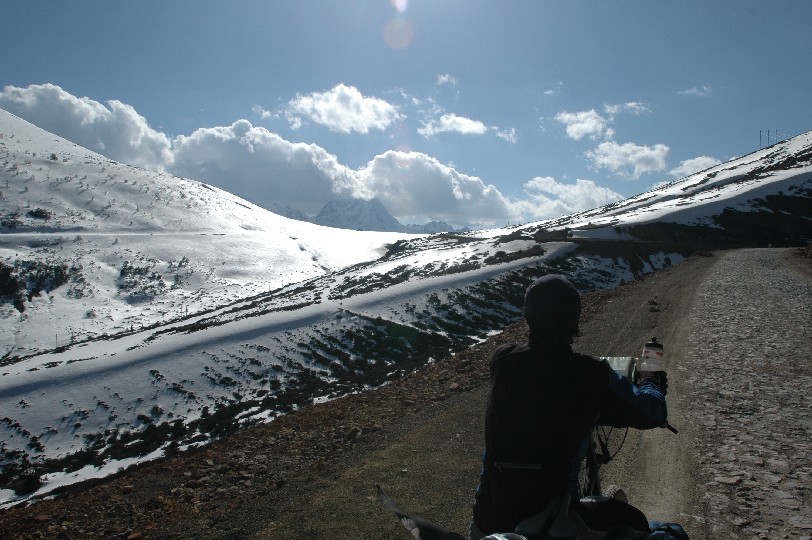
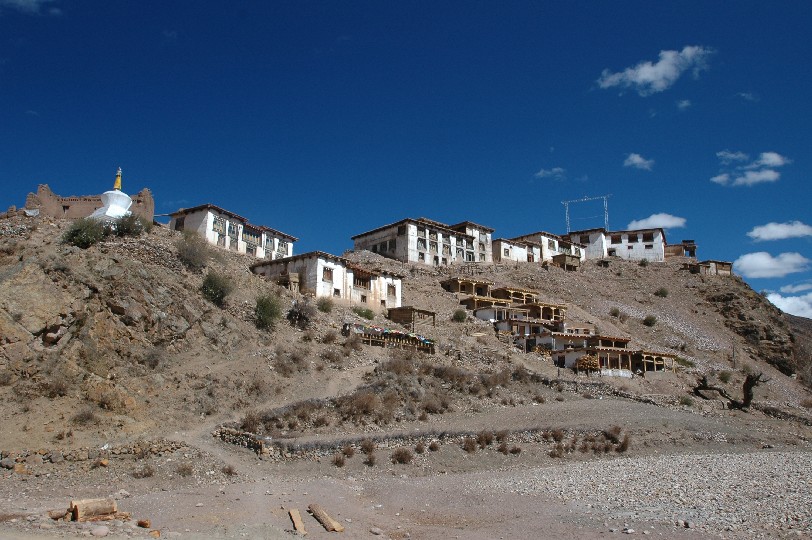
The other images that go through our minds are the ones of all those passes, valleys and summits. As we ride from pass to pass, at 4000m, 4500m and even 5000m above sea level, it is difficult to say what we feel with words. The mountains have this ability to make you feel so happy. As we climb them, it is like they are telling us: we make this pass hard to get to, we protect them, with lots of climbing, wind, snow storms and lack of oxygen. But if you are determined enough to get to the top, then you deserve to know us a bit better, to discover a few of our secrets. How many times have we got to the top of a pass, fighting incredible wind or snow storms, and a ray of sun decides to come through to reveal astounding landscapes. How many times, as we are at the end of it, exhausted by the kilometers, the climbing, the bumpy roads, how many times do we then see a torrent, or beautiful colourful Tibetan flags, a gorge or a glacier that seem to cheer for us. Of course, we are happy to have gone over all these passes, surrounded by 7000m peaks. To our surprise, each pass makes us discover a new valley, so different from the previous one: landscapes, architecture and even the animals seem to change from one valley to the other. Here, there are mainly yaks around, there, there will be more horses. Here we are surrounded by vultures but in the next valley, the sky is full of eagles looking for their prey.
On top of the physical challenge of these last 3 weeks, there was the psychological challenge. After Yanjing, we had to ride another 3 times in the night to avoid the police check points. The second check point was in Markham, some 100km north of Yanjing. This town has a very bad reputation as far as checkpoints go. We are stiff and stressed on our bikes: cold, fear (as mike would say at that time: "what do we tell them if we get caught? It was about 2am and I could not sleep any longer so I decided to go for a ride, with no lights whatsoever...?") and the uncertainty to know whether we were going to make it through or not. And then, there it is: the control gate, all lit up in the middle of the night. But the PSB officer must have gone to the loo or something as we cannot see anyone around. Our pulse is beating so fast. Mike's handsign says to remain silent. We lean forward and down on our bikes, we go under the control gate, noone calls for us. We don't dare turning around. We have made it through, mike's victory sign in the night is a relief: second obstacle is over. We start to relax - but not for long. About 1 km after the check point, a dog is waiting for us, screaming and barking sickly. He throws himself onto Mike, planting his teeth in his pannier bags. Yvoine pedals hard to get away (extremely courageous...) while Mike wheels around and goes after the dog. Who runs away. "Show them that you are not afraid, Yvoine, that is the best solution..." The next check point, 400km from Lhasa, we will go through it under heavy snow, with almost no visibility. We barely miss an accident with a couple of cows having a catch up in the middle of the road at 4am and a motorcyle driving on the wrong side of the road, with no lights on... The last check point is our arrival into lhasa, in a rain storm that then turned into a snow storm. We are so tired, and cold, but it barely matters: we have made it. A hot shower, a bed, some food other than tsampa (barley flour) and noodles are waiting for us. Lhasa is still asleep at this hour. We find a small cafe half open half close that offers us liters of yak butter tea. We must truely look exhausted and cold because they keep pouring us more tea, and get us to drink faster so we can have more. At the other end of the room, a monk got a prayer book brought to him. About 1 meter long and 15 cm wide, the buddhist scripts were brought hidden under colourful sheets. He sings the sacred texts, in a low and monotonous tone, as we are getting warmer...
We would like to only talk about this Tibet. About these awesome mountains, about the wind that blows, whistles, comes in gusts and storms and barely misses getting us off our bikes. We would like to only talk about the great fights between snow or rain storms and sun. About the fantastic camps over 4000m above sea level. About the warm and great welcomes along the road. About those devoted Tibetans who along the road pray and walk, pulling their cart, on their way to Lhasa. It is the pilgrim of their lifetime: they walk for hundreds, thousands of kilometers to get to Lhasa, their forehead touching the ground at every step. But besides all of this, we have also encountered not so warm welcomes, such as those kids in a couple of villages that threw rocks at us. As we pedaled away and turned back, we saw the parents punishing them for their attitude... by throwing rocks at them... Finally, we cannot not mention the accelerated and incentivised Han immigration into Tibet, threatening to make the Tibetans a minority in their own country, as well as the unbelievably large amount of police, army convoys and uniforms covering the region (far more than in Yunnan where the police was already quite present).
Finally, as if to say to the Tibetans and to the rest of the world that the situation will not be otherwise, that Tibet will be Chinese, is already Chinese: this monument to the glory of the red army, standing in front of an empty Potala palace in Lhasa. Cold, rude, devout of respect.
//
you can see more photos by visiting the photolibrary.
