desert crossing
From Quetta, we have some 800 km of desert ahead of us to reach Zahedan. Zahedan is the first town on the Iranian side, about 100 km away from the border. We have studied the map of Balochistan, asked all the questions we could think of: where can we find water? food?... The answers aren't usually much help since almost systematically, we get told not to go there. Take a train. Or a bus. One cannot possibly cycle across the Balochistan desert. All these words that we keep hearing, telling us not to go, always for very good reasons: temperature, sand storms, various dangers, dangerous thieves with guns...
We decide to go anyway, and if it gets too hard, we should be able to find a bus or a truck on the road.
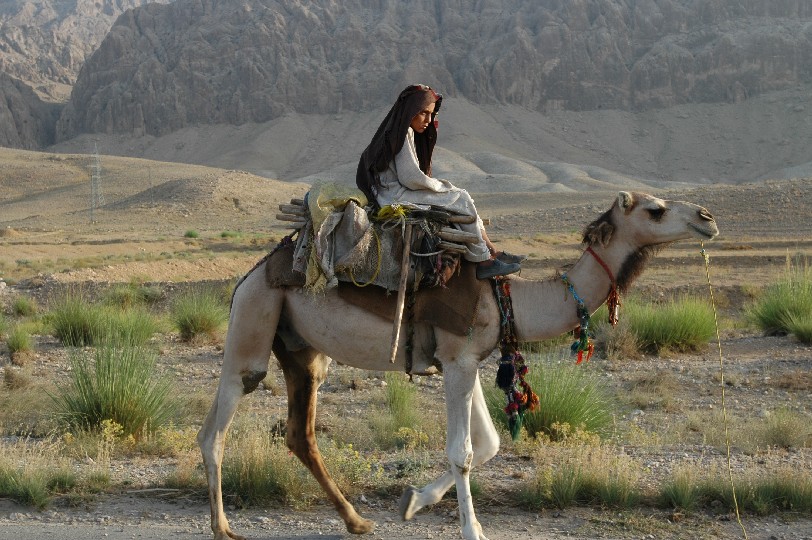
We don't need to cycle very far out of Quetta for the scenery to become very arid, kind of "empty". The trees, the orchards, even the houses that we could see here and there in the Eastern part of Balochistan have all but disappeared. Even the cows have gone! Only a few herds of goats and sheep are left. As well as some proud camels, whose silhouettes are so sharp and so visible in those vast surrounds. They walk with style, proud, their head very straight, and their hump taking on the pace. To start with, the horizon ends with some small arid mountains on either side of us. But soon, those hills disappear as well, leaving us in the middle of endless horizons: we are crossing a great desertic plateau, at about 900 meter above sea level.
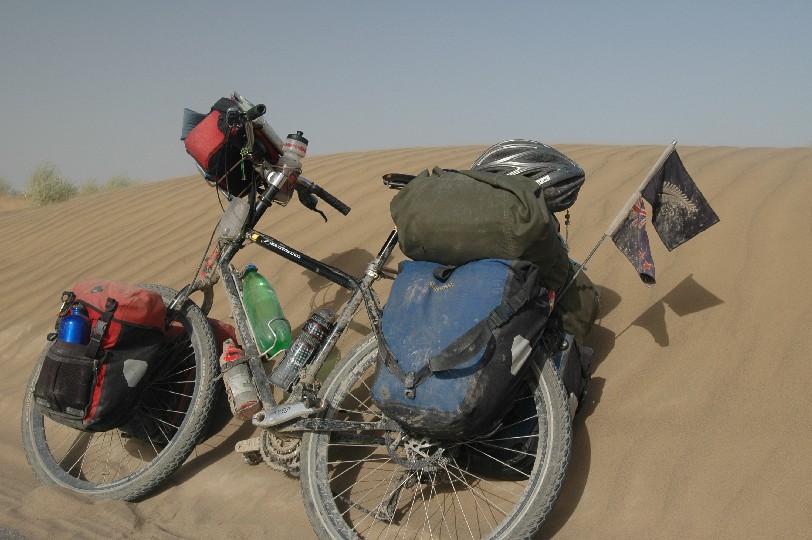
Nothing troubles these spaces. All we can see is sand, a few sand dunes, and a couple of scrubs here and there. Wherever our eyes look, they see endless, infinite horizons. Ahead of us, the road is dead straight, and disappears in the distance. We avoid looking back, because what we see is the same. When we drive at night, we can see the headlights of the trucks dozens of minutes before they actually pass us coming the other way, because the road is so straight and so long.
And so, as we pedal accross this desert, we get to understand how the desert can make one go mad. Our small bodies - they do seem so small and so fragile in this environment! - are fighting the elements. Like the waves that never stop crushing on the beach, these elements never ever seem to stop testing us. In our minds, we so badly hope for a break, that never comes. 2 cyclists cannot possibly trouble what seems to have been this way for so long. The air is hot and dry. So dry in fact that it takes the air out of our lungs, like steam. So dry that our throats are on fire and our sinuses sting. Our top and bottom lips, burnt and cracked, are so hot when touching each other they almost burn. The sun, impossible to disturb, beats down on us. Its rays filter into everything and everywhere. A real fire ball. Unbelievable how this ball can be so productive and so destructive at once.
And the wind, oh the wind. We had not thought about it. But it blows, and blows strongly. Our memorys are sent back to our Tibetan days. Except that here, the wind picks up sand on its way, blasting our faces and getting into everything: our ears, our nostrils, our eyes. With no interruption, at night, during the day, the wind blows hard, in the wrong direction of course. So we fight, looking for an escape. But there is no escape on this immense plateau. No obstacles, nothing to make the wind turn or stop. No valleys, no mountains, no trees. The wind blows without every getting tired. And so we fight, with the tenacity of those who know there is no other way. We are making very slow progress. But still, we are making progress. We would like to get the wind to shut up, it makes us deaf. The wind that sometimes is like music to our ears when on our bikes is here a demon that makes us sick. We swear at it. We beg it to stop, even if for a minute. But to no avail. We keep cycling forward, a meter at a time, accepting and determined.
These elements never seem to get tired, or disturbed. They keep at it, so regularly and constantly. That is what makes you go crazy. It makes a conversation difficult, virtually impossible. And so, our support and cheering for one another have to limit themselves to our mere presence next to each other. We take turns: 1 km in front fighting the wind, 1 km behind to rest (the one in front acting as windshield). And again, 1 km in front. Kilometer after kilometer, we slowly make progress. With for only conversation, the sound of the wind and silence. We are left to ourselves. Asking ourselves questions we don't want to think the answers of. Like, when is the wind going to stop? Never. When is this road going to turn? A few hundreds km to go. When will we get to the next oasis? A few hours. So, to avoid going crazy, we stop asking ourselves those questions. And we just concentrate on the task at hand: 1 km in front, 1 km behind, 1 km in front... We find refuge in our minds, with all these happy memories, from past and future. We think of those we will meet again in Europe at the end of the year. All these friends and family, so far away. We imagine ourselves in their homes at Christmas. The heat coming from the fireplace at Villarbernon (Yvoine's family home) with a little brother that is being a fool (as usual) but who is damn good at making a fire, and a father who opens his best bottle of wine simply for the joy of being together. Another welcoming home in the mountains with a great big wooden table in the lounge, delicious jams, and a special stash of chocolate hidden in a drawer under the kitchen bench. Memories of the best breakfasts shared in beloved homes, in the middle of winter. Memories of numerous week-ends spent with friends, baking pizzas in traditional woodfire ovens. Or making apple juice. Memories of so many expeditions in the snow, eating pasta sandwiches and talking rubbish. Flashes of a Cyril carrying a ridiculously small backpack and a ridiculously small sleeping bag for the spring mountain conditions. Or memories again of a Damien arriving blowing his horn, with a few dozens bottles of HIS wine in the boot of his car. A wine that tastes so good because it is drunk and shared in frienship and laughter... Hundreds, thousands of these memories come back. Small colourful flashes that help us push and pull on the pedals. Friendship is pushing us. Family is pulling us. And so we keep making our way westward.
These surrounds also offer magnificent spectacles at times, moments to enjoy. The last hour of the day, in particular, we look forward to. When the sun, usually so harsh and glary, finally becomes gentler. When at last, we can look at it, as it turns orange. A golden tennis table ball slowly going down in the sky, giving out a light so warm and so rich. A fireball that, for an hour, lets itself be admired and that finally lets us pedal in a cooler 30 to 35 degree temperature. The stary skys we get to stare at from our tent are also very special. Huge. Bright. Making us dream.
We ride at night, at dawn or at dusk. In the middle of the day, we try to find a small oasis where we get to drink tea and eat chapatis. Thus protected from sun, wind and sand. On the road, when we run out of water (we drink about 2 litres per person per hour), we stop a truck (they carry litres of water). These few minutes we get to spend with truckdrivers are minutes spent in paradise. They admire us with conviction because they know this desert so well, driving across it week after week from Quetta to Iran and back (remark: most of the trucks on this road are actually buses carrying merchandise. When we ask one of the truck-turned-bus drivers about this phenomenon, his answer seems obvious! Given the size and structure of the desert road, strict weight restrictions are enforced on trucks. But not on buses, supposed to carry passengers and therefore not cause any problems. So the solution is simple: here, buses carry merchandise, therefore escaping the weight controls. Our truck-driving friend here for example carries no less than 20 tons of rice to the Iran border, all piled up somehow on his bus. He then drives back from the border to Quetta with 20 tons of oil!). They share with us a peach, a bit of fresh water or a few pieces of sugar. Before they head back on the road, honking their horn as loud as they can. So for sure, we love those truck drivers!
We have now cycled 600 slow km accross the desert. The border with Iran does not seem that far anymore: 70 km. But we are lacking sleep, cycling at night and not sleeping during the day because of the heat. Our bodies too are showing signs of fatigue. And the wind, bloody wind, never stops and gets us to progress at the incredible speed of 5 kph on the flat! We are gathering all our strength and weight not to fall over. We cover our faces so we don't swallow too much sand. In fact, the sand storms are so strong here that we can barely see the road, covered in sand. We think about the simple mathematics in our heads: 70 km at an average of 7 kph... When do we get there? It is 4 o'clock in the morning. We have been pedaling for 3 hours, after a 3-hour night. We are lying on the side of the road, drinking and eating a bit before heading back on the road. A bus stops to offer us some water, and a seat for 70 km to the border. We are so tired we just accept the offer. And fall asleep straight away. But these 70 km on the bus seem to give us back some real energy. We cross the border, and keep pedaling (still with strong head winds but on a better road) some 100 km to Zahedan, Iran.
In Zahedan, we rest for 2 days. Indeed, ahead of us still lies 350 km of desert, but Iranian desert this time. Our last bit of desert before heading into the mountains.
//
you can see more photos by visiting the photolibrary.
